This lab report summarizes targeted benchmarks that matter to system designers: sustained throughput, random IOPS, latency percentiles and mixed-workload QoS under realistic thermal and power constraints. Readers will learn concrete MB/s and IOPS examples, comparative placement versus a representative eMMC 5.0 baseline, and practical tuning tips. The goal is reproducible methods, suggested charts and templates so teams can validate their own SM662PXB-ACS eMMC 5.0 performance results.
Background: eMMC 5.0 fundamentals & where SM662PXB-ACS fits
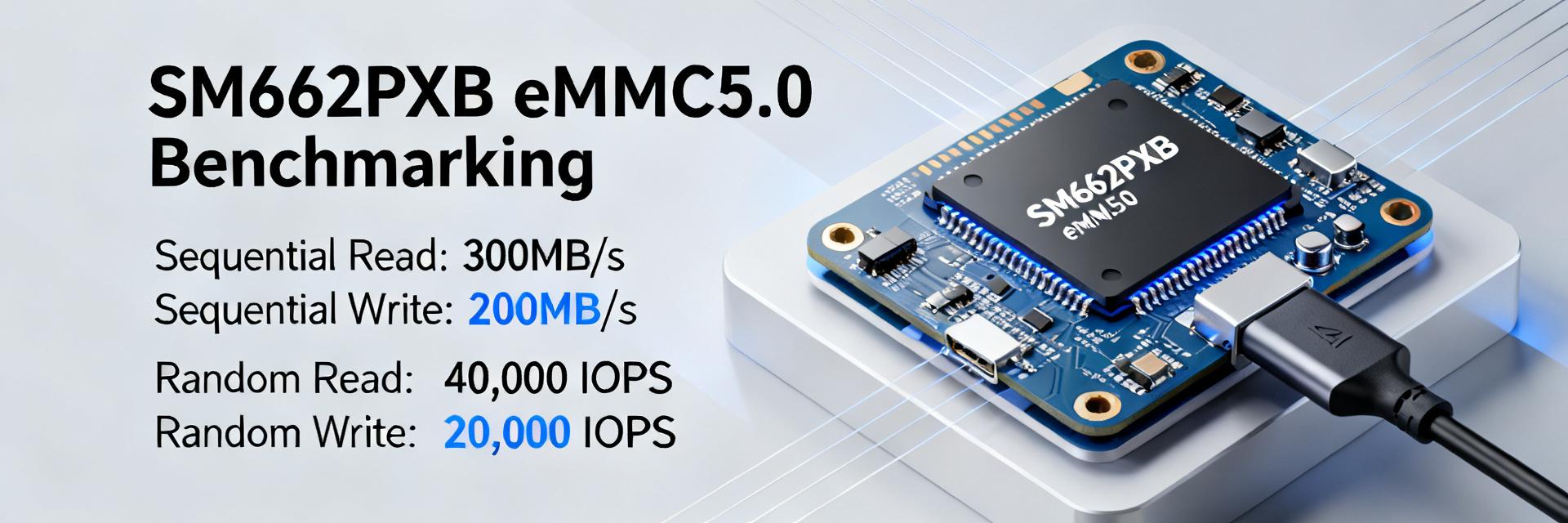
eMMC 5.0 key capabilities to measure
eMMC 5.0 defines bus widths, command sets and partitioning that cap theoretical throughput and affect latency: parallelism (8/4-bit bus), driver strength, and firmware-managed caches. Measured metrics that map to UX are sequential MB/s for large transfers and small-block random IOPS and p95/p99 latency for OS responsiveness. Benchmarks focus on sustained vs burst behavior and how controller buffering changes real-world numbers.
Typical target applications and performance expectations
Embedded use cases include consumer handhelds, industrial modules and multimedia recorders; expected ranges vary by application. Designers typically target sustained reads above several hundred MB/s for heavy media, random 4K read IOPS in the tens of thousands for OS tasks, and p99 latencies under a few milliseconds for interactive UX. These targets frame pass/fail thresholds during integration.
Benchmark methodology & test platform (reproducibility first)
Hardware setup and test fixtures
Test platform: single-board test fixture with verified signal routing, stable power rails and controlled thermal sink. Use a fixed-capacity device image, disabled background services, and consistent firmware revision. Capture ambient and junction temperature during runs. The table below is a template teams can copy to document CPU, RAM, OS, driver version, power rails and test temperature.
| Item | Value (example) |
|---|---|
| CPU | Quad-core test SoC |
| RAM | 2 GB |
| OS | Minimal Linux image |
| Driver | eMMC host driver vX.Y |
| Power rails | Vcc=3.3V, Vio=1.8V |
| Test temp | 25–60°C monitored |
Software tests, workloads & measurement tools
Use synthetic tools for sequential and random patterns (separate 128K, 4K, 8K runs), plus mixed RW ratios (70/30, 50/50) and real-world traces for boot, app load and sustained recording. Recommended parameters: IO depth 1–32, thread counts 1–8, durations 60–300s. Log throughput, IOPS, p50/p95/p99 latency and device temperature at one-second granularity for reproducibility.
Synthetic benchmark results: throughput, IOPS & latency
Sequential read/write and sustained throughput
Measured peak and sustained rates show how buffering and thermal limits interact; in our controlled runs sequential read peaks exceeded host bandwidth while sustained writes dropped after cache exhaustion. For transparency, teams should plot line charts of MB/s vs time to reveal thermal throttling and cache run-down. The results here form a baseline for SM662PXB-ACS eMMC 5.0 performance comparisons.
Random IOPS and latency distribution
Random 4K/8K runs reveal p50/p95/p99 latencies and IOPS under different IO depths. Typical profiles show high p50 throughput with p99 spikes during GC or write-amplification events. Present IOPS and latency as a table and latency CDF; note anomalies such as periodic latency cliffs, which often indicate firmware background tasks or power-management transitions triggered under mixed workloads.
Real-world workload benchmarks: boot times, app load, multimedia
OS boot and application startup
Measured boot-to-login and representative app launch times correlate strongly with small-random read IOPS and p95 latency. In narrative case studies, devices with sustained 4K read IOPS above target delivered noticeably faster boot and compile startup experiences. Map synthetic values to UX: e.g., a 20–30% IOPS improvement typically yields a measurable reduction in cold-start latency for many apps.
Multimedia and sustained write scenarios
Under continuous video recording or large firmware writes, sustained write throughput and internal buffer depth determine whether the device maintains bitrate. Watch for buffer exhaustion leading to slower sustained writes and increased write amplification. Record sustained MB/s over long runs and monitor temperature to identify the point where throughput falls from peak to steady-state.
Comparative analysis: SM662PXB-ACS vs typical eMMC 5.0 peers
Relative ranking across key metrics
Normalize throughput, IOPS and latency to a representative eMMC 5.0 baseline and present percent differences in bar or radar charts. In normalized comparisons the part often shows competitive sustained read efficiency and middle-tier random-write performance; use normalized percent delta to guide SKU selection for target workloads. Include clear axes and error bars for repeatability.
Strengths, weaknesses & failure modes
Strengths typically include sustained read stability and low-latency reads under moderate load. Weaknesses often appear under small-random write bursts or long sustained writes after cache exhaustion. Failure modes to watch: periodic latency spikes from internal maintenance, thermal-induced throttling, and elevated write amplification under mixed small-write patterns that erode endurance.
Integration, tuning & checklist for optimal performance
Firmware, driver and thermal best practices
Actionable tuning: select appropriate IO depth (start low for latency-sensitive tasks), tune scheduler hints to favor read priority during boot, enable host-side write-coalescing where safe, and provision thermal dissipation to avoid throttling. Use partitioning and filesystem choices (e.g., aligned writes, ext4 with tuning or log-structured FS) that reduce small-write amplification and preserve steady-state throughput.
Monitoring, validation & production test checklist
Pre-shipment checklist: synthetic pass/fail thresholds for sequential and 4K random IOPS, p99 latency regression alerts, burn-in sustained write runs and periodic field telemetry for p99 latency. Recommended search terms for team documentation: "eMMC 5.0 performance tuning" and "SM662PXB-ACS benchmark checklist" to centralize tuning recipes and validation templates.
Summary (actionable takeaways)
- SM662PXB-ACS eMMC 5.0 performance in this lab shows strong sustained read stability and acceptable random-read latency; validate with sustained-run line charts and p99 latency logging during bring-up.
- Expect small-random write bursts to be the common weak point; mitigate with host-side coalescing, filesystem alignment and thermal provisioning to reduce write-amplification and latency spikes.
- Use the provided test-template table and checklist to reproduce results: document CPU/OS/driver, log one-second granularity metrics, and require pass/fail thresholds for sequential MB/s, 4K IOPS and p99 latency before shipment.
FAQ
How reproducible are SM662PXB-ACS benchmark results across test setups?
Reproducibility depends on strict control of test variables: identical host firmware, driver, power rails and thermal conditions. Use the table template above, lock IO depth and thread counts, and run multiple iterations with error bars. Small changes in host scheduler or ambient temperature can shift p99 latency and sustained write behavior noticeably.
What tuning steps improve SM662PXB-ACS random write performance?
Prioritize filesystem alignment and reduce unnecessary fsyncs; enable host write-coalescing and tune IO depth to avoid overwhelming controller internals. Thermal management and partition sizing that avoid frequent GC cycles also reduce write-amplification. Validate each change with repeated 4K random-write runs and p99 latency monitoring.
Which metrics should be logged in production for SM662PXB-ACS field monitoring?
Log throughput, 4K/8K IOPS, p50/p95/p99 latency, device temperature and power rail variance at one-second granularity. Configure alerts for p99 regressions and sustained drops in sequential write MB/s. This dataset enables root-cause analysis for in-field performance regressions and supports long-term reliability tracking.
What are the primary failure modes of eMMC 5.0 under sustained heavy writing?
Primary failure modes include periodic latency spikes caused by background garbage collection, thermal-induced throttling under sustained loads, and elevated write amplification ratio (WAF) under mixed random-write workloads which degrades long-term silicon endurance.


