Current US search and traffic signals show rising mobile-first queries and longer-tail transactional phrases that convert at higher rates; operators who align content and paid creatives to intent capture more high-value sign-ups. This article provides a compact, actionable playbook operators and marketers can use to identify high-intent opportunities and lift acquisition ROI.
1 — Market background: who’s searching for casino sites and why
1.1 Audience segments to prioritize
Point: Prioritize cohorts by conversion propensity. Evidence: segment into intent-driven converters, casual browsers, and geo/regulatory-constrained users using demographic splits, device share, and time-of-day peaks from GA4 and CRM. Explanation: Start with intent-driven converters (mobile users in permissive states, evening peaks) because they show highest micro-conversion rates and fastest LTV signal.
1.2 Search intent taxonomy
Point: Map queries to four intent buckets. Evidence: transactional (“sign up casino bonus”), informational (“how to play blackjack”), navigational (“[brand] casino login”), comparative (“best casino apps for slots”); report expected funnel stage and CTR ranges. Explanation: Use review templates for comparative, conversion landing pages for transactional, and FAQ-rich guides for informational queries with explicit CTAs matched to each funnel stage.
2 — Search analysis: trends, volume, and SERP behavior
2.1 Keyword trend signals to track
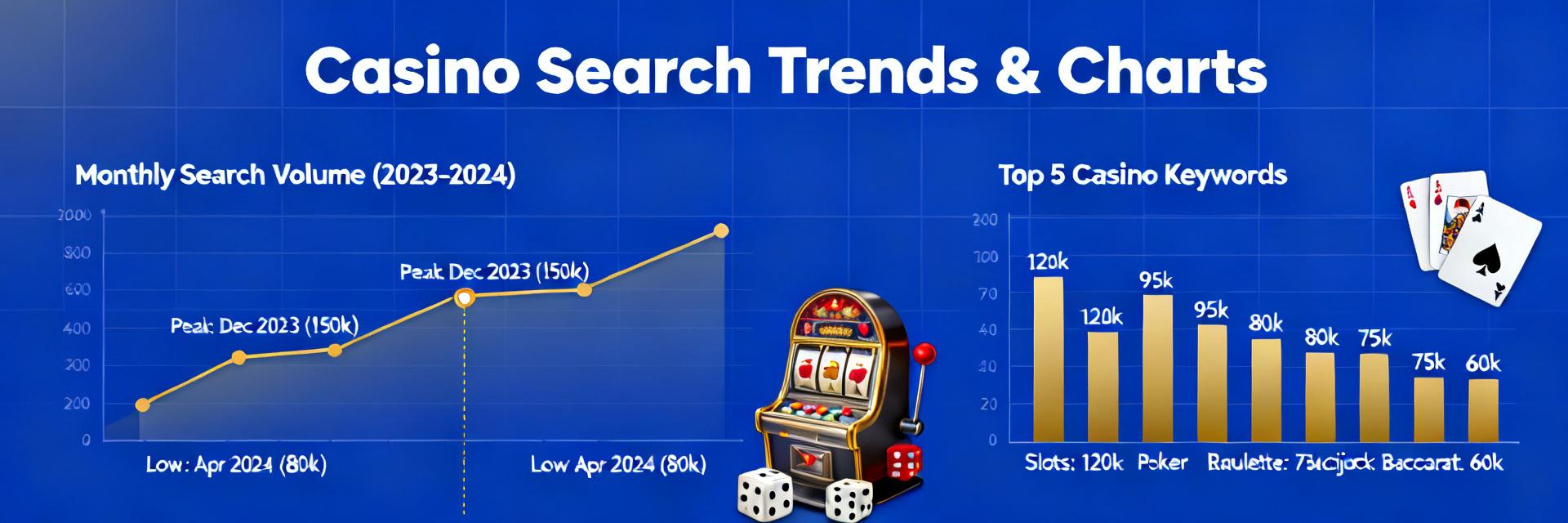
Point: Track volume shifts and device mix monthly. Evidence: export Search Console queries, GA4 device reports, and keyword-tool trend lines for last 12 months; monitor rising long-tail phrases with 30–300 monthly volume but high conversion intent. Explanation: Flag terms with consistent month-over-month growth >10% and mobile share >60% for rapid content targeting and paid tests.
| Intent Bucket | Example Query | Primary Asset | Expected CTR |
|---|---|---|---|
| Transactional | “sign up casino bonus” | Conversion Landing Page | 15% - 25% |
| Comparative | “best casino apps for slots” | Review Template / Listicle | 8% - 14% |
| Informational | “how to play blackjack” | FAQ-Rich Guide | 3% - 7% |
| Navigational | “[brand] casino login” | Direct Portal / Homepage | 50%+ |
2.2 SERP features & ranking opportunities
Point: Optimize for SERP features that steal or deliver clicks. Evidence: monitor presence of local packs, video snippets, People Also Ask and ads in sample SERPs; estimate CTR lift/decline by feature using rank-share analysis. Explanation: Implement schema, FAQ blocks, and featured-snippet-friendly H2s to reclaim organic clicks and add short-format video to compete in video snippets.
3 — Traffic drivers breakdown: organic, paid, affiliates, and direct
3.1 Organic & content-driven acquisition
Point: Focus content that matches high-intent queries. Evidence: produce how-to guides, reviews, local game pages and evergreen FAQs; measure baseline CTRs, expected ranking timelines (8–16 weeks) and content velocity (2–4 pieces/week). Explanation: Prioritize pages that answer transactional intent with clear CTAs, fast mobile UX, and strong internal links to deposit flows to improve assisted conversions.
3.2 Paid, affiliates, and partnership channels
Point: Align paid and affiliate channels to query intent. Evidence: track CPC/CPL and conversion rate by creative, and landing-page performance; use search ads for transactional intent and programmatic/affiliate for broader reach where allowed. Explanation: Match ad copy and landing pages to the query bucket to raise quality score, lower CPC, and improve conversion—test creative sets weekly for signal.
4 — SEO & acquisition playbook for casino sites
4.1 High-impact on-page and technical SEO fixes
Point: Execute a prioritized technical checklist first. Evidence: audit title/tags, intent-aligned H1s, canonicalization, mobile-first indexing and site speed; quick wins often lift organic in weeks (titles, meta descriptions, and removing duplicate content). Explanation: Implement server-side caching, compress images, and update title templates to reflect intent—measure rank and organic assisted conversions weekly.
4.2 Content and backlink strategies tailored to regulated market constraints
Point: Build compliant content pillars and non-branded partnerships. Evidence: create game guides, promotions pages, and local compliance pages; pursue PR-driven placements, resource pages, and editorial mentions rather than paid or incentivized links. Explanation: A steady cadence (one pillar + two support posts monthly) plus ethical link-building supports sustainable authority growth under US regulatory realities.
5 — User journeys & channel scenarios (case-based guidance)
5.1 Example A: New user acquisition via search (informational → transactional)
Point: Design a 3-step funnel from content to sign-up. Evidence: informational article → comparative review → transaction landing page with promo; instrument via GA4 events for content interactions, lead form starts, and deposits. Explanation: Track micro-conversions (time on page, CTA clicks) and expect 1–3% content-to-deposit conversion; optimize flows with retargeting for drop-offs.
5.2 Example B: Reactivation & retention via paid + content
Point: Combine remarketing with tailored content to re-engage lapsed users. Evidence: run CRM-segmented search and display campaigns pointing to personalized offers and “what’s new” content; measure uplift in reactivation and ARPU. Explanation: Use frequency caps and tailored creative; expect 10–30% uplift in reactivation rates for well-targeted cohorts over 30–60 days.
6 — Actionable roadmap: prioritized tests and 90-day plan
6.1 Quick experiments (30 days)
Point: Run 3 immediate A/B tests. Evidence: Test (A) updated intent-matching title/meta, (B) hero CTA copy emphasizing bonus and risk info, (C) mobile speed fixes; define success as +10–20% lift in CTR or reduced bounce. Explanation: Use rapid-release cycles, measure via GA4 and search console, and promote winners to landing pages and paid creatives.
6.2 Medium-term initiatives (90 days)
Point: Scale successful experiments into programmatic processes. Evidence: implement site architecture changes, publish pillar series, and onboard affiliate partners with compliance checklists; set KPI targets for organic assisted conversions and CPL improvements. Explanation: Convert learnings into quarterly programs: cadence, templates, and partner playbooks to sustain growth.
Summary
- Prioritize mobile-first, intent-driven cohorts for casino sites: target transactional long-tail queries with conversion-focused landing pages and fast mobile UX to maximize conversion propensity and reduce CPL.
- Use targeted search analysis and SERP-feature optimization to reclaim clicks: track rising queries, implement schema and FAQ blocks, and add short video to capture snippets and improve CTR.
- Run quick experiments and scale winners: test intent-matched titles, hero CTAs, and speed fixes within 30 days, then expand successful content and affiliate plays across a 90-day program.
Frequently asked questions
How should casino sites prioritize search intent for fastest ROI?
Answer: Prioritize transactional and close-comparative intent first—identify queries with conversion signals and mobile dominance. Evidence-driven prioritization uses Search Console and GA4 to rank terms by intent, volume trend, and conversion rate; then map to optimized landing pages and paid bids for immediate ROI.
What traffic drivers deliver the best performance for casino sites?
Answer: Organic content aligned to high-intent queries plus conversion-focused paid search typically deliver highest ROI. Organic reduces CPL over time; paid secures volume quickly. Measure assisted conversions and CAC to balance investment between channels and optimize creative/landing alignment.
Which single metric should operators watch first to measure success?
Answer: Organic-assisted conversions from high-intent queries—this metric ties search analysis and traffic drivers to business outcomes. Track it weekly in GA4, segment by query intent and device, and use it to prioritize content and paid tests that move the needle.
What is the recommended timeline for seeing SEO results in regulated markets?
Answer: Expectations should be set for an 8–16 week timeline for organic rankings, driven by a consistent content velocity of 2–4 high-intent pieces per week combined with compliant, PR-driven link acquisition.


